In honour of my brother.
- May 6
- 5 min read
***Content Warning: This piece includes themes of suicide, lost lives and grief. If these topics are sensitive for you, please pause and consider your current mental health before reading.***

I’ve been a volunteer on the water for almost 30 years, mostly in search and rescue. I’ve seen the river at its best and its worst, and it’s shaped the way I understand trauma, leadership, and people.
But I didn’t start out fearless. When I was 17, my twin brother Paul drowned. Losing him left me with a fear of the water that stayed for years. I never thought I’d go back near it. It was a friend of mine who inspired me to join Marine Rescue to get me back on the water. I always loved water. Water has been in my blood and an important part of my family for years.
Fast forward 3 decades… I spent 16 years with Marine Rescue Queensland (formerly Volunteer Marine Rescue), and another thirteen with the State Emergency Service.
The work has become part of who I am.
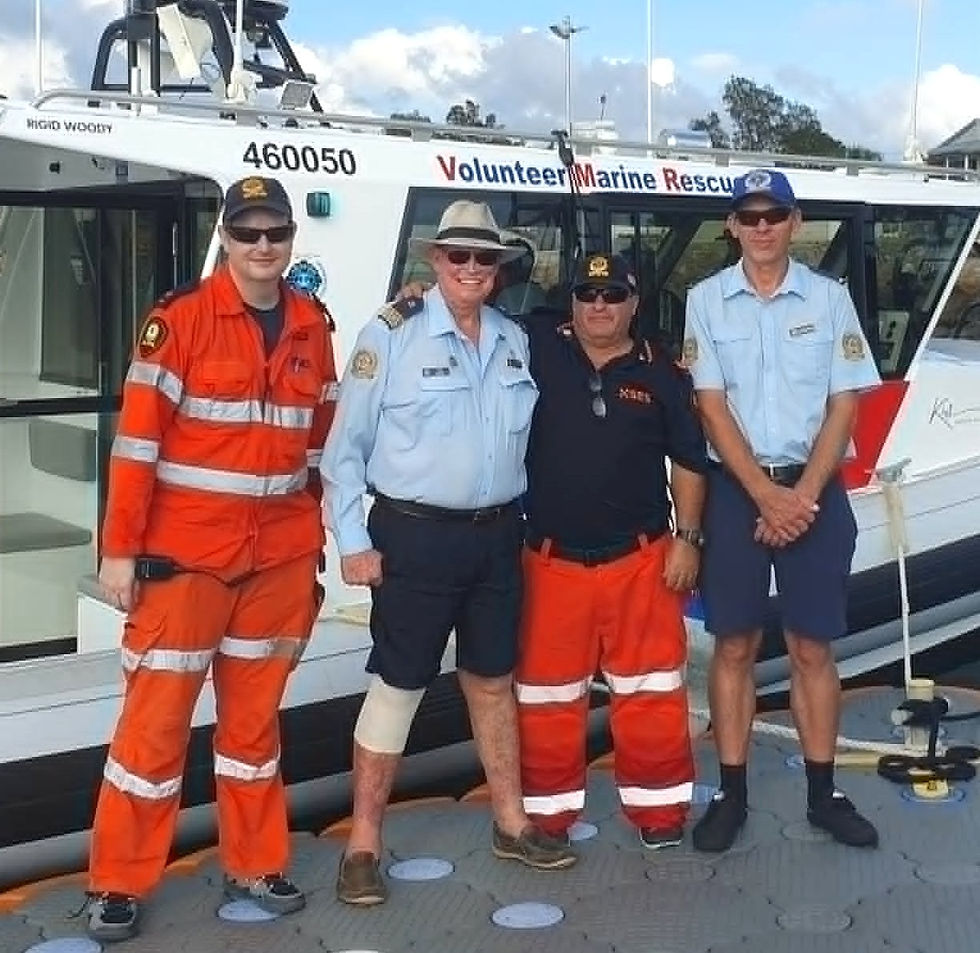
Most people think the hardest part of volunteering is the cold, the dark, the long nights, or the things you see.
It’s not. The hardest part is what happens inside your own head afterwards.
Over the years I’ve learned something about myself: when I hit the point where I can’t think straight, when the adrenaline crashes and the noise in my brain turns to static, I go straight into tactical breathing. Four seconds in, four seconds hold, four seconds out. Repeatedly until something inside me clicks back into place.
It’s like hitting a reset button. I go from zero to one. One to two. Two to three. And eventually, I can think again.
I’ve done it on boats, in traumatic jobs, even in hospital when a nurse asked why my heart rate was so low. She was the first person who ever looked at me and said, “Are you somewhere else right now?” And I was. I had to be.
In March, we were called to the Brisbane River to search for a young man who’d gone missing. I had a new crew with me. Good people, but green. So, I talked them through everything as we went. Running commentary helps them process what they’re seeing, and it helps me stay steady.
When the other boat found him, we moved in to shield the scene from the public. My crew saw more than most volunteers ever do, let alone on their first major job. They saw the recovery, the police, the paramedics, the coroner. They saw the family arrive. They heard the wailing, deep, cultural grief that hits you in the chest.
Even I teared up.
And then something happened that I’ll never forget. The family lined up along the riverbank and raised their hands to us. A gesture of acknowledgement, of thanks, of recognition.
My whole crew cried. So, did I.
Most people know about debriefs. Very few know about Critical Stress Management.
It’s not counselling. It’s not a quiet chat in a back room. It’s everyone who was affected: volunteers, duty officers, partners, and kids, sitting around a table and talking through what happened from their own eyes.
Because trauma doesn’t just hit the person on the boat. It hits the person waiting at home, wondering if you’re safe. It hits your kids, even if they never say a word.
So, I organised a session. Every crew member spoke. Every family member spoke. All the gaps in the story closed.
And something shifted.
People admitted things they were too embarrassed to say out loud: like how some of us laughed at a moment during the recovery, not because it was funny, but because sometimes humour is the only pressure valve your body has left. I thought I was the only one who reacted that way. Turns out I wasn’t.
That night fixed something in me. It gave us all closure. It stopped the job from turning into something heavier.
I realised how important closure is. My crew needed it. Their families needed it. And I needed it more than I admitted.
…….
A week later, I was called to another job: another body in the river. This time I taught the crew the questions no one else thinks to ask: How many days in the water? Beer or spirits? What were the tides doing? Will he float or sink?
I taught them how to read the river, how to predict drift, how to stay calm when the city cats don’t stop and the current is working against you.
And when the body surfaced, bloated, face‑down, impossibly buoyant despite a hidden weight belt, I talked them through every step again. Not to shield them, but to help them process it in real time.
“There’s no script for this,” he says. “You learn. You adapt. You reset.”
If there’s one thing I’ve learned, it’s that none of us should carry this work alone. The river teaches you that. And so does time.
Why He Still Shows Up
Ron has seen more than most volunteers ever will. He’s carried things home that he was never meant to carry. He’s lost sleep. He’s held crews together. He’s held families together. He’s held himself together with breathing and grit and a lifetime of experience.
He’s also saved lives, including reviving a fellow VMR member at Bribie Island collapsed, stopped breathing and had no pulse. His vessel master, John, called for Ron because he had advanced resuscitation. Ronnie raced upstairs with the defib and revived him.
Moments like that stay with you just as much as the losses do.
And still, he shows up. Not because it’s easy. Not because he’s fearless. But because someone needs be calm when everyone else is falling apart.
“Everyone has a threshold,” he says. “What breaks one person might not break another. But we all need closure. We all need to process. If you can’t process it, you’re fucked.”
He laughs when he says it, but he means it.
Ron says he isn’t a hero. He doesn’t want to be one.
He’s a volunteer who has learned the hard way that trauma doesn’t end when the job ends. That families carry the weight too. That humour can save you. That breathing can reset you. That talking can heal you. That silence can break you.
And that sometimes, on the river, in the dark, with a crew of people who trust you, you get to witness something sacred:
A family raising their hands in gratitude to the strangers who brought their loved one home.
….
In 2026, Ron received a City of Moreton Bay Australia Day Award: Mayor’s Community Spirit Award for his professionalism, expertise and commitment to training that has directly improved community safety.


Comments